Video Analysis
Edward Yardeni, President of Yardeni Research, shares his personal investing strategy, emphasizing a bullish outlook on the equity market. Due to his busy schedule, he primarily invests in ETFs, particularly those tracking broad market indices like the S&P 500 and Nasdaq 100, reflecting his belief in long-term market growth and the technology sector.
- Edward Yardeni is bullish on the equity market.
- He invests in ETFs, citing the S&P 500 and Nasdaq 100 as good performers.
- He believes technology is a leading sector in the economy.
Warren Pies of 3Fourteen Research discusses the current market landscape, highlighting oil prices as a key inflation driver that could pressure the Fed. He recommends overweighting U.S. stocks and commodities, believing the market has already seen a significant correction beneath the surface, and that a Fed rate hike now would be a mistake.
- Oil prices are up significantly for the month, posing a potential threat of market normalization and influencing Fed policy decisions.
- 3Fourteen Research recommends an 'Overweight' position in U.S. Stocks and Commodities, and an 'Underweight' position in U.S. Bonds and Cash/Bills.
- Pies argues that a Fed rate hike would be a mistake, as current inflation is largely supply-driven (oil) and other economic areas like housing and wage growth are decelerating.
- Despite index performance, the average S&P stock is down over 18% from its one-year high, indicating a 'below the surface' correction, with the semiconductor sector showing high implied volatility but potential for recovery.
Peter Navarro discusses the Trump administration's strategy to rebuild its tariff program, targeting unfair trade practices like forced labor and industrial overcapacity, particularly from China and the EU. He defends new tariffs and criticizes the EU's digital taxes on US tech companies, while also advising the Federal Reserve against raising interest rates during an energy price shock.
- The Trump administration is implementing new tariffs (10-12.5%) on 60 economies, including the EU, citing violations of forced labor laws and industrial overcapacity, aiming to level the playing field for American businesses.
- Navarro criticizes the EU's digital taxes on major US tech companies (Google, Meta), viewing them as discriminatory 'piggy bank' tactics that warrant retaliatory tariffs.
- Navarro strongly advises the Federal Reserve against raising interest rates in response to the current energy price shock, arguing that such a move would induce a recession rather than effectively combat supply-side inflation.

Compass International Holdings CEO Robert Reffkin asserts that the housing market bottomed last year and is now turning a corner, driven by increased affordability and strong regional demand. While mortgage rates remain a concern, he anticipates continued growth, especially in tech-heavy areas like San Francisco and pro-business states like Florida.
- June new home sales exceeded expectations, rising 1.6% month-over-month to 628K, breaking a two-month slump.
- Median new home prices are down 2.7% year-over-year to $398.3K, making homes more affordable and attracting buyers.
- San Francisco's housing market is currently the 'hottest,' fueled by anticipated IPOs from companies like SpaceX, OpenAI, and Anthropic.
- Miami's market is robust due to its pro-business environment and favorable taxes, attracting residents from high-tax states.
- New York City home prices are increasing, despite new taxes on second homes, driven by strong demand and job opportunities.
Jeff Korzenik, Chief Economist at Fifth Third Commercial Bank, discusses the economic impact of tariffs and the Federal Reserve's inflation target. He believes that a structural shift away from globalization is contributing to inflation, making it difficult for the Fed to meet its 2% target. Korzenik recommends the Fed hold steady this year, as rising bond yields are already helping, and suggests their 2% inflation target might be outdated.
- Tariffs have not had a significant macro negative economic impact thus far, but a structural shift away from globalization is a key factor influencing inflation.
- The Fed's core inflation measure excludes energy prices due to their variability and the fact that monetary policy is not effective in controlling them.
- Korzenik advises the Fed to 'talk tough' but 'hold steady' this year, awaiting task force conclusions, as rising bond yields are already contributing to the Fed's work.
- He suggests that tightening labor markets will likely force the Fed's hand in 2027 and that the Fed's current 2% hard inflation target, established in 2012 for a deflationary environment, may be inappropriate for today's economy.

The market concluded a losing week, with major averages down for two consecutive weeks, driven by geopolitical tensions, rising inflation, and high mortgage rates. Analysts question the continued dominance of 'Magnificent Seven' stocks, with only Nvidia posting a winning week. The upcoming week is set to be the busiest for earnings, featuring major tech companies and a Federal Reserve meeting.
- Major averages were down for the week and two weeks in a row, with only Nvidia among the 'Magnificent Seven' having a winning week.
- Geopolitical tensions (Iran war, US-EU tariffs) and rising inflation/interest rates are significant market headwinds, impacting consumer budgets and housing.
- The upcoming week features a busy earnings season, including Apple, Amazon, Microsoft, and Meta, alongside a Fed meeting on interest rates and economic data.

Wharton Professor Jeremy Siegel discusses current market dynamics, highlighting the underperformance of the 'Magnificent 7' tech stocks and the sharp rise in WTI crude oil prices. He emphasizes the critical nature of the upcoming FOMC meeting, where the Fed's stance on inflation, especially core inflation and rising energy costs, will significantly influence future interest rate policy and market valuations.
- The 'Magnificent 7' tech stocks experienced their biggest drop relative to the S&P 500 in four years, indicating a market rotation.
- WTI crude oil prices have surged from $70 to $90 per barrel in two weeks, raising concerns about inflationary pressures.
- The upcoming FOMC meeting is crucial, with potential for a hawkish tilt from some Fed members due to persistent inflation, despite hopes for oil prices to decline.
- Siegel notes that while current interest rates are not yet a threat to risk assets, rising real yields (10-year Treasury at 2.5%) could challenge the stock market's current 5% earnings yield (20x P/E).

AMD CEO Lisa Su discusses the accelerating AI market, projecting a $2 trillion opportunity by 2030, with the accelerator market alone reaching $1.4 trillion. She highlights AMD's new Helios rack-scale AI system, its full production status, and significant performance improvements. Su emphasizes strong customer demand, rapid AI adoption, and strategic partnerships with companies like Anthropic, Meta, and OpenAI, underscoring AMD's commitment to an open ecosystem.
- The total AI market opportunity is projected to reach $2 trillion by 2030, with the accelerator market contributing $1.4 trillion.
- AMD's Helios rack-scale AI system, featuring MI455 architecture and Venice CPUs, is in full production, offering over 30x performance improvement.
- AI adoption is accelerating faster than anticipated, driven by the increasing productivity and utility of AI agents.
- AMD has strategic partnerships with OpenAI (5GW), Meta (6GW), and a $5 billion investment in Anthropic (2GW), focusing on collaborative development within an open ecosystem.
- Lisa Su notes continued strong demand from hyperscalers, indicating no slowdown in AI infrastructure investment.

Ireland's Ambassador Geraldine Byrne Nason discusses US-EU trade relations amidst new tariff threats from former President Trump. She emphasizes Ireland's desire for stable trade and clarifies the EU's stance on digital market regulations and fines against tech giants, highlighting the non-discriminatory nature of these policies.
- Ireland and the EU generally oppose tariffs, viewing a recent 10% global tariff announcement as positive compared to a 15% ceiling.
- Former President Trump announced a 301 investigation into EU actions on US tech, accusing the EU of 'robbing' American companies.
- Ambassador Nason explains that EU fines on companies like Google, Apple, Meta, and Amazon are non-discriminatory efforts to prevent market abuse under the Digital Services Act.

The discussion centers on the US-China AI race, arguing that the real debate is about the risks of Chinese open-weight AI models. Michelle Giuda emphasizes that the US won't win by merely limiting China's tech but by proactively building a trusted, world-class, and price-effective American open-weight AI ecosystem to diffuse its technology globally.
- The primary concern is the national security and corporate risks posed by untrustworthy Chinese open-weight AI models, citing examples like Huawei and TikTok.
- The US needs to 'turbocharge' its own open-weight AI ecosystem to provide a robust, price-effective, and trusted alternative for businesses globally.
- Winning the AI race requires a proactive US approach focused on innovation and trusted alternatives, rather than solely on restricting Chinese technology.

Edward Yardeni discusses the Federal Reserve's interest rate policy, stating that the Fed may need to raise rates up to three more times to address inflation. He emphasizes the resilience of the economy and the labor market, viewing current interest rates as a return to 'normal' and a sign of economic health, rather than an abnormal 'higher for longer' scenario. He believes the market will continue to defy bearish predictions.
- Yardeni expects the Fed to raise interest rates at least once, possibly two or three more times, to tackle inflation.
- He views current interest rates (e.g., 4-5% 10-year Treasury yield) as 'normal' and indicative of a healthy economy, contrasting them with the 'abnormal' low rates post-Great Financial Crisis.
- He maintains a bullish outlook, stating that the market will continue to defy bears due to the economy's resilience and strong labor market (4.3% unemployment).

Analysts discuss the impact of rising oil prices on inflation and the Federal Reserve's upcoming interest rate decision, noting mixed signals from Fed members. Despite strong earnings, market reactions are muted due to elevated expectations and a rotation out of mega-cap tech. Credit markets show modest widening in tech spreads, driven by high capex spending, but overall corporate fundamentals remain sound.
- Rising oil prices (up 10% this week) complicate the inflation outlook, potentially negating recent CPI relief.
- The Fed's next meeting is seen as a 'coin flip' for a rate hike, with market probabilities for July at 35.8% but increasing for later in the year.
- Strong earnings are not surprising the market due to already elevated expectations, leading to a rotation out of mega-cap tech stocks.
- Credit markets are 'well-behaved' overall, but tech spreads are widening due to high capex spending and supply/demand dynamics, raising questions about return on investment.

Ariel Investments' Charles Bobrinskoy expresses a cautious outlook on the current market, highlighting that stocks, particularly growth stocks, are overvalued. He notes that while EPS growth appears strong, cash flow growth is weaker due to massive capital expenditures, and warns that favorable conditions for bank stocks are cyclical and unlikely to persist.
- Value stocks have significantly underperformed growth stocks over the past 15 years, but historically outperform over longer periods.
- Current market valuations are generally expensive, with growth stocks still overpriced based on standard methodologies.
- Strong EPS growth is misleading; cash flow growth is much worse due to massive capital expenditures, which overstate current earnings.
- Bank stocks are no longer attractively priced, trading at almost three times book value, a level typically seen during peak cyclical conditions.

The video discusses how artificial intelligence (AI) is reshaping the battlefield, shifting from expensive, complex systems to lower-cost, high-production autonomous units. Trae Stephens, co-founder of Anduril Industries, emphasizes the importance of manufacturing scale and AI leadership for U.S. national security, highlighting the competition with China. He also addresses the growing opportunities and potential investment bubble in defense tech.
- AI is transforming warfare by enabling the development of lower-cost, high-production autonomous systems, such as cruise missiles and collaborative combat aircraft.
- Anduril Industries' strategy focuses on rapid, scalable manufacturing of defense technology, with the belief that 'the factory is the weapon' in modern warfare.
- The U.S. must lead in AI to maintain global balance of power, strengthen deterrence, and protect national security, especially against competitors like China.
- Autonomous systems are crucial for protecting human life by allowing computers to execute dangerous missions based on human command intent.
- While there's a 'defense tech investment bubble' with high valuations, significant opportunities exist within the AI stack, including compute, chip design, and utility-scale power.

Kamakshya Trivedi of Goldman Sachs discusses the dollar's performance amidst re-escalating geopolitical tensions and persistent inflation concerns. He notes that while the dollar's initial reaction was muted, it is now beginning to appreciate due to rising energy prices and its status as a relatively high-yielder, with carry considerations dominating returns.
- Inflation forecasts are not de-escalating, and geopolitical re-escalation (e.g., two straits blocked) is occurring from a point of lower global energy inventories.
- The dollar's initial impact was muted, with a reluctance to fully commit to energy price increases in currency and inflation markets.
- However, with sustained increases in gas prices in Europe and oil prices, the dollar is now beginning to appreciate and acquire a 'front-footed nature'.
- Carry considerations are dominating returns, and the market is respecting the dollar's relatively high-yielder status, leading to global bond declines on fresh inflation concerns.
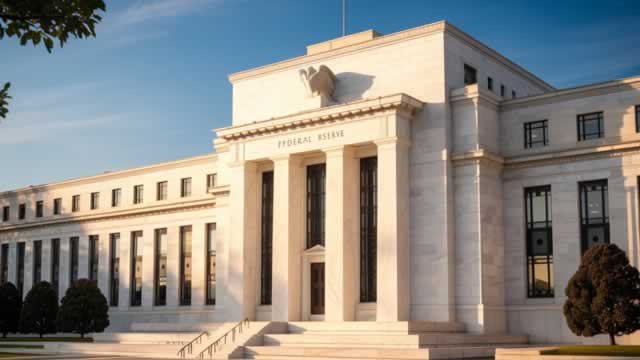
Neil Dutta of Renaissance Macro Research argues that the Federal Reserve should tactically hike rates now, citing inflationary pressures from AI demand, energy prices, and tariffs. He believes Fed Chair Warsh has a window of opportunity to secure a hike before committee consensus potentially shifts, despite Dutta's own dovish view on the uneven economy.
- The Fed should hike rates now due to inflationary pressures stemming from AI demand, rising energy prices (due to war), and tariffs.
- Tactically, Fed Chair Warsh should implement a rate hike now while he has control over the committee, as it may be more challenging to do so in September.
- Dutta expresses a dovish perspective, highlighting an uneven economy where monetary policy, a blunt tool, could exacerbate stresses in non-AI sectors.
- Even FOMC members currently signaling a hold are unlikely to maintain that stance for long, suggesting a hike is probable.
- If the Fed does not hike next week, long-term yields could continue to push higher, and the President's reaction might be negative closer to the midterms.

Matt Smith from Kpler discusses the ongoing geopolitical conflict's impact on energy markets, highlighting prolonged disruptions to key shipping lanes like the Strait of Hormuz and Bab el-Mandeb. He anticipates oil prices, especially for refined products such as diesel and gasoline, to continue rising, with the Strait of Hormuz reopening not expected until next year.
- The ongoing conflict has no clear end in sight, leading to sustained geopolitical risk for energy markets.
- Key shipping chokepoints, including the Strait of Hormuz and Bab el-Mandeb, are experiencing disruptions, with the Strait of Hormuz reopening now pushed into next year.
- Despite current WTI crude prices around $89, Smith expects overall oil prices to push higher, with refined products like diesel ($180/barrel) and gasoline ($140/barrel) already under significant strain and expected to worsen.
The video discusses the escalating US-Iran conflict, particularly in the Red Sea due to Houthi attacks. Col. Wayne Sanders (Ret.) outlines potential US military responses to Iran, including targeting IRGC bases, missile production, and potentially nuclear sites, highlighting the strategic risks involved.
- US previously aided Saudi Arabia in degrading Houthi military capabilities in the region.
- Current Red Sea tensions are viewed as an Iranian strategy to exert pressure on the US.
- Potential US targets in Iran include IRGC Navy bases, missile production facilities, drone manufacturing, air defense, and possibly nuclear sites like Natanz, Isfahan, and Fordow.
- Long-range missile sites in Yemen and coastal forces supporting the Houthis could also be targeted in response to Red Sea disruptions.

The video discusses escalating tensions between the US and Iran, with President Trump threatening a 'massive attack' amid ongoing strikes and Houthi rebels targeting Saudi oil tankers. This geopolitical instability is severely impacting global oil supply routes, causing Brent crude prices to surge past $100 a barrel, with analysts forecasting potential rises to $150-$200 due to supply disruptions and low inventories.
- President Trump warns of a 'massive attack' on Iran, citing 13 consecutive nights of US strikes on Iranian targets and Iran's alleged desire for 'more pain' before negotiations.
- Iran-allied Houthi rebels have struck Saudi oil tankers in the Red Sea, threatening the critical Bab el-Mandeb strait and the East-West pipeline, which serves as a bypass for the effectively closed Strait of Hormuz.
- The disruption to these vital shipping choke points, combined with already low global oil inventories, has driven Brent crude prices above $100/barrel, with experts suggesting prices could reach $150-$200/barrel.

The discussion focuses on former President Trump's 'Ratepayer Protection Pledge' for AI energy costs, specifically addressing data centers. Expert Alex Epstein advocates for data centers, highlighting their economic benefits for local communities and their role in powering AI, while attributing rising electricity costs to anti-fossil fuel policies and poor permitting, not data centers.
- Trump's 'Ratepayer Protection Pledge' aims to make AI companies pay for new power needs and data center upgrades.
- Alex Epstein praises data centers as economic boons, generating tax revenue and improving local services.
- He argues that rising electricity costs are due to anti-fossil fuel policies and bad permitting, not data centers.
- He recommends inspiring people about AI benefits, addressing concerns, and streamlining permitting for data centers.